
How many restrooms does a county fair need?
Start with attendance, not gut feel. ANSI/PSAI Z4.3 sets the baseline service interval at once a week for 10 users over a 40 hour stretch, but a fair is a compressed crowd over a weekend, so the math changes fast. A single-day fair with 2,000 attendees typically needs more units than that standard implies because everyone is there at once, not spread over a workweek. We size events off headcount, hours, and whether food and beer are being served, since drink lines mean more restroom trips per hour. Our how many porta potties do I need guide walks through the ratio in more detail. For a multi-day fair in Paterson, we also build in a mid-event service pass so units do not run down by day two. If the fairgrounds sit near a food court or beer garden, we cluster extra standard porta potty rental units there specifically, since that is where lines back up worst. ADA compliance is not optional at a public event: 213.2 requires at least 5 percent of clustered units be accessible, never fewer than one, and our ADA accessible porta potty units meet the 60 inch turning circle called for under ADA 304.3.1. For fairs expecting a strong family crowd, we often recommend adding a deluxe flushable porta potty near the main gate for a better first impression.
What restroom options work best for a fair setting?
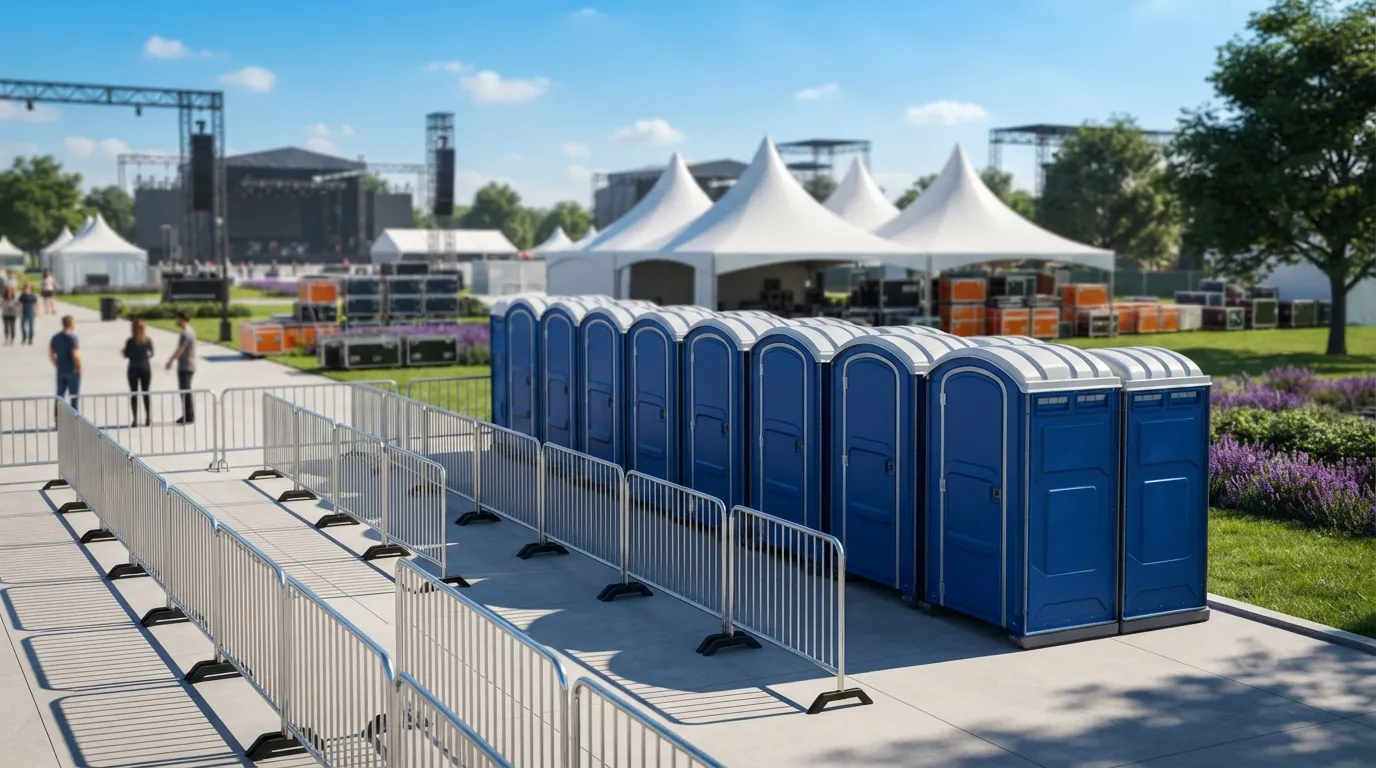
Standard units handle the bulk of foot traffic, but a fair benefits from mixing in something better near main stages, beer tents, or VIP areas. A restroom trailer rental gives fairgoers flushing toilets, running water, and real stalls instead of a single-seat unit, and for a fair the size of a county event, a 4 stall restroom trailer or 8 stall restroom trailer keeps lines moving during peak hours. Smaller satellite fairs closer to Paterson, like ones held out toward Fair Lawn (4.1 miles northeast) or Hawthorne (3.9 miles north), often pair trailers at the main gate with standard units scattered near parking. Handwashing matters more at a fair than almost anywhere else because of food service: 29 CFR 1910.141(d)(2) requires soap and towels or a hand drying device at washing stations, and sanitizer alone does not satisfy that rule. We place handwashing station rental units directly outside food vendor rows for that reason, and a portable sink rental works well near funnel cake stands and BBQ trailers where hands get greasy fast. If your fair runs late into the evening, pair restroom placement with light tower rental units so the walk to the units stays lit and safe. Crowd flow also matters, and crowd control barrier rental or a run of temporary fence rental helps keep restroom lines orderly instead of spilling into walkways.
Where should restrooms be placed on fairgrounds?
Placement follows foot traffic, not the map's empty corners. Units belong within a short walk of the busiest zones: main stage, food court, livestock barns, and parking entrances, so nobody hikes across a field to find a stall. Ground surfaces at fairgrounds are often grass or gravel, so ADA Standards section 302.1 requires the route to each accessible unit stay stable, firm, and slip resistant, which sometimes means we lay temporary matting under wheels and walkways. The accessible route itself needs at least 36 inches of clear width per ADA 403.5.1, and unit doors need a 32 inch clear opening under ADA 404.2.3, so we check both before setting anything down. Delivery trucks need roughly 60 feet of straight clearance to place a roll-off or larger trailer, which matters on fairgrounds with tight service roads. We also handle trash: a roll-off dumpster rental sized right for expected crowd volume keeps food waste and packaging from piling up around restroom clusters, since a full dumpster next to a restroom row is the first thing people complain about. For fairs running multiple days, we schedule a service pass between days rather than waiting until the whole event ends, keeping tanks under capacity the whole run. Anyone planning a fair near Elmwood Park (3.0 miles east) or Garfield (4.8 miles southeast) can compare setups on our event restroom rental page, and our festival restroom rental page covers similar crowd-density events if your fair leans more toward music and vendors than livestock and rides.
| unit | duration | typical price |
|---|---|---|
| standard | weekend | $250 |
| standard | event | $400 |
| ada | weekend | $240 |
| trailer | weekend | $2,000 |
| trailer | event | $3,500 |
Check current numbers on our porta potty rental cost page, or request a quote sized to your fair's actual headcount.
How far in advance should I book restrooms for a fair?
Book as soon as dates and expected attendance are set, ideally a few months out for a full county fair. Trailers and ADA units book first since supply is limited. Waiting until the final month often means settling for whatever standard units are left rather than the mix you actually wanted.
Do fairgrounds need ADA-compliant restrooms?
Yes. Public events open to the general public need accessible units under ADA Standards section 213.2, which requires at least 5 percent of a cluster be accessible and never fewer than one. Reach and operable-part rules under 308.2.1 and 309.4 apply to fixtures inside each unit too.
How often are restrooms serviced during a multi-day fair?
We schedule at least one mid-event service pass for multi-day fairs, more often if attendance runs high or weather adds strain. See how often are porta potties cleaned for the standard interval and what changes it.
Can Paterson Porta Pros handle food vendor handwashing requirements?
Yes. We place handwashing stations meeting 29 CFR 1910.141(d)(2) near vendor rows, since that rule requires soap and towels or a hand drying device, not sanitizer alone. Vendors handling raw food especially need stations within easy reach of their booths.
What happens to waste and trash during the fair?
We pair restroom service with roll-off dumpsters sized to expected crowd volume, plus a mid-event pickup on longer fairs. See dumpster sizes and dimensions to figure out what size fits your footprint and expected trash volume.
Next step
Get a delivery date
Tell us the address, the dates and the headcount. We size the order and confirm the route.